
Home / Services / Loft Insulation
Building fabricLoft insulation, laid to depth and without blocking the eaves.
Mineral wool to 270 mm in two layers, ventilation paths kept clear, and the hatch, pipes and tank dealt with properly. It is usually the lowest-cost fabric measure and the one most often done badly.
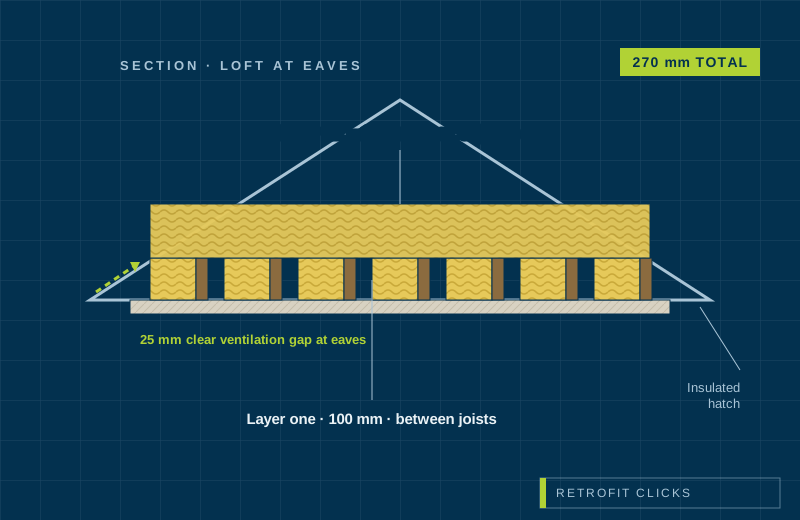
Two layers, crossed
The first layer goes between the joists, usually 100 mm. The second goes across them at right angles, usually 170 mm, which is what covers the joists themselves and stops them acting as a line of cold bridges straight through the insulation.
That second layer is the one that gets skipped. A loft with 100 mm sitting neatly between the joists is roughly half-insulated, and it is a common find on surveys.
Ventilation and the things in the loft
Insulation pushed hard into the eaves blocks the airflow the roof void needs, and a cold unventilated loft gets condensation. We keep a clear gap at the eaves and fit ventilation trays where the pitch is shallow.
Pipework and any cold-water tank sit above the insulation, in cold air, so both get lagged. The hatch gets insulated and draught-sealed — an uninsulated hatch is a hole in the middle of an otherwise good job. Downlights and flues get kept clear to the required distance.
If you store things up there
Laying boards straight onto the joists squashes the insulation flat and undoes most of the benefit. If you need storage, we raise the deck on loft legs so the full depth stays loose beneath it, and board only the area you actually use.
What this covers
- Mineral wool laid in two crossed layers to 270 mm
- Topping up existing insulation to current depth
- Clearing and removing failed or contaminated insulation
- Eaves ventilation trays and clear airflow paths
- Loft hatch insulation and draught sealing
- Pipe lagging and cold-water tank insulation
- Raised loft boarding over full-depth insulation
- Room-in-roof and sloping-ceiling insulation
Common questions about loft insulation.
How much loft insulation do I need?
270 mm of mineral wool is the commonly recommended depth for an uninsulated loft, laid in two crossed layers. Existing insulation can often be topped up, depending on its condition.
Can I still store things in the loft?
Yes. A raised deck on loft legs keeps the full depth of insulation loose beneath it, and only the area you use gets boarded.
Is it safe to insulate around electrics and downlights?
Cabling is checked first, and downlights need the right clearance or a suitable cover. Anything that has to be sorted before insulation goes down is flagged in the survey.
Often needed alongside this.
 Building fabric
External Wall Insulation
EPS or mineral wool board fixed to solid walls, then basecoat, mesh and finish render — the biggest single fabric gain on a solid-wall home.
View service → Building fabric
Insulation Measures
Cavity wall, underfloor, room-in-roof and flat-roof measures, specified from what the survey finds rather than from a catalogue.
View service → Building fabric
Retrofit Works
Surveys, measure-by-measure costings and the works themselves, sequenced so fabric, ventilation and services do not fight each other.
View service →Get this priced.
Email contact@retrofitclicks.com with the address and a short description, or use the enquiry form. Building work is surveyed before it is quoted.